"Red anger rises": Art and revolt in the 2012 Québec student strike
How performance, poetry, and red squares animated the largest student strike in Canada's history
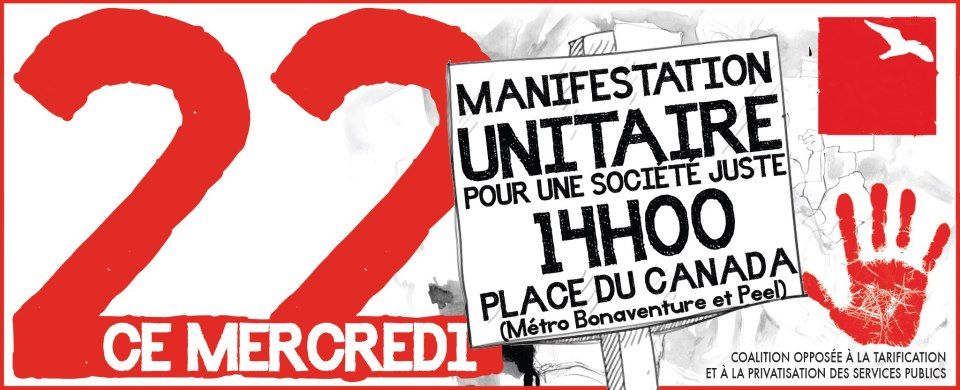
On March 22, 2012, upwards of 200,000 people took to the streets of Montréal, Québec—one of the largest demonstrations the city had ever seen. Alain Savard, a student organizer, remembers that day as "breathtaking." Crowds filled the streets as far as the eye could see, with painted banners and home-made signs. This was the peak of the "printemps érable" or the "Maple Spring," a student general strike beginning in February 2012 that lasted seven months and involved around half of all Québécois university and college students. Upwards of 460,000 students refused to go to class and shut down their college and university campuses. The main issue at stake was the provincial government's proposal, under Jean Charest, to increase tuition fees by 30 percent, or $1,625 CAD, over five years. Later that spring, the protests swelled to include labor unions, community groups, and broader civil society.
Savard, who had been working as an organizer for several years in the build-up to the strike, looked around that day in March. "This is magic," he thought. "This is far beyond anything I had envisioned, because I was planning this for so long. I was like, at this point, we've already won."
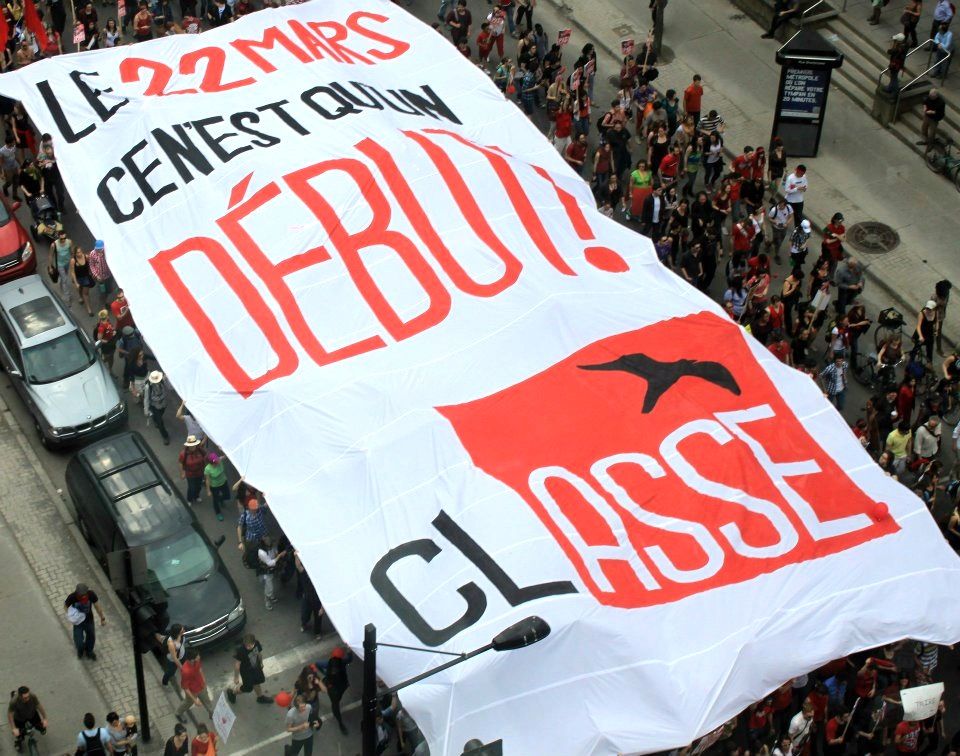
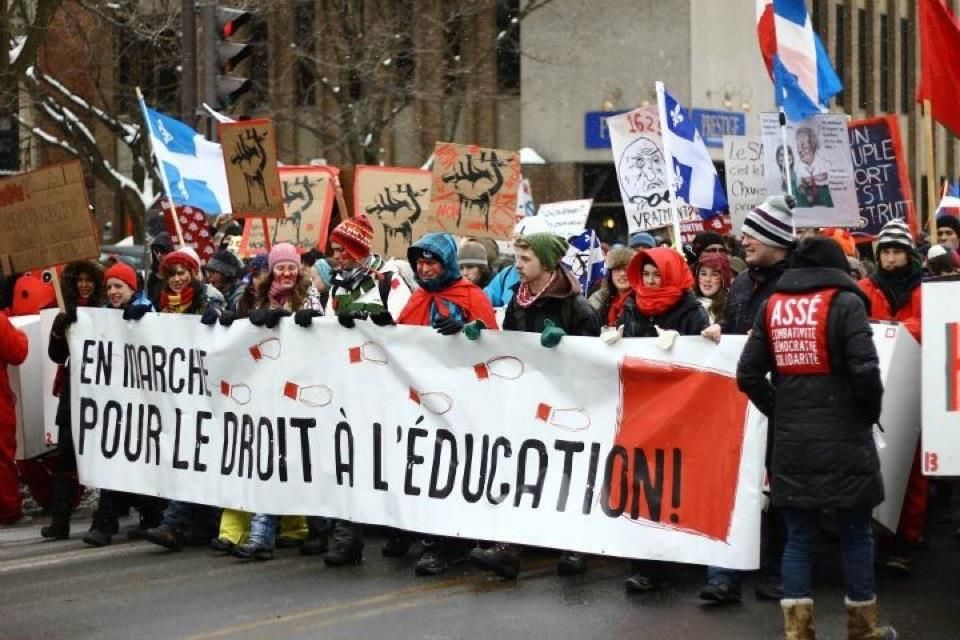
Everywhere, there was evidence of the students' creativity. One group of students, their bodies painted red, pushed a yellow canoe down the street, its sail a red square emblazoned with the words: Éducation à la Dérive (Education Going Adrift). Elsewhere, a group of architecture students from Université de Montréal wearing black lay down in the middle of the roadway, large red cubes on their backs reading: 1625 Fois Trop Lourde (1625 Times Too Heavy), a reference to the proposed $1,625 increase in fees. They were symbolically being "crushed by debt."
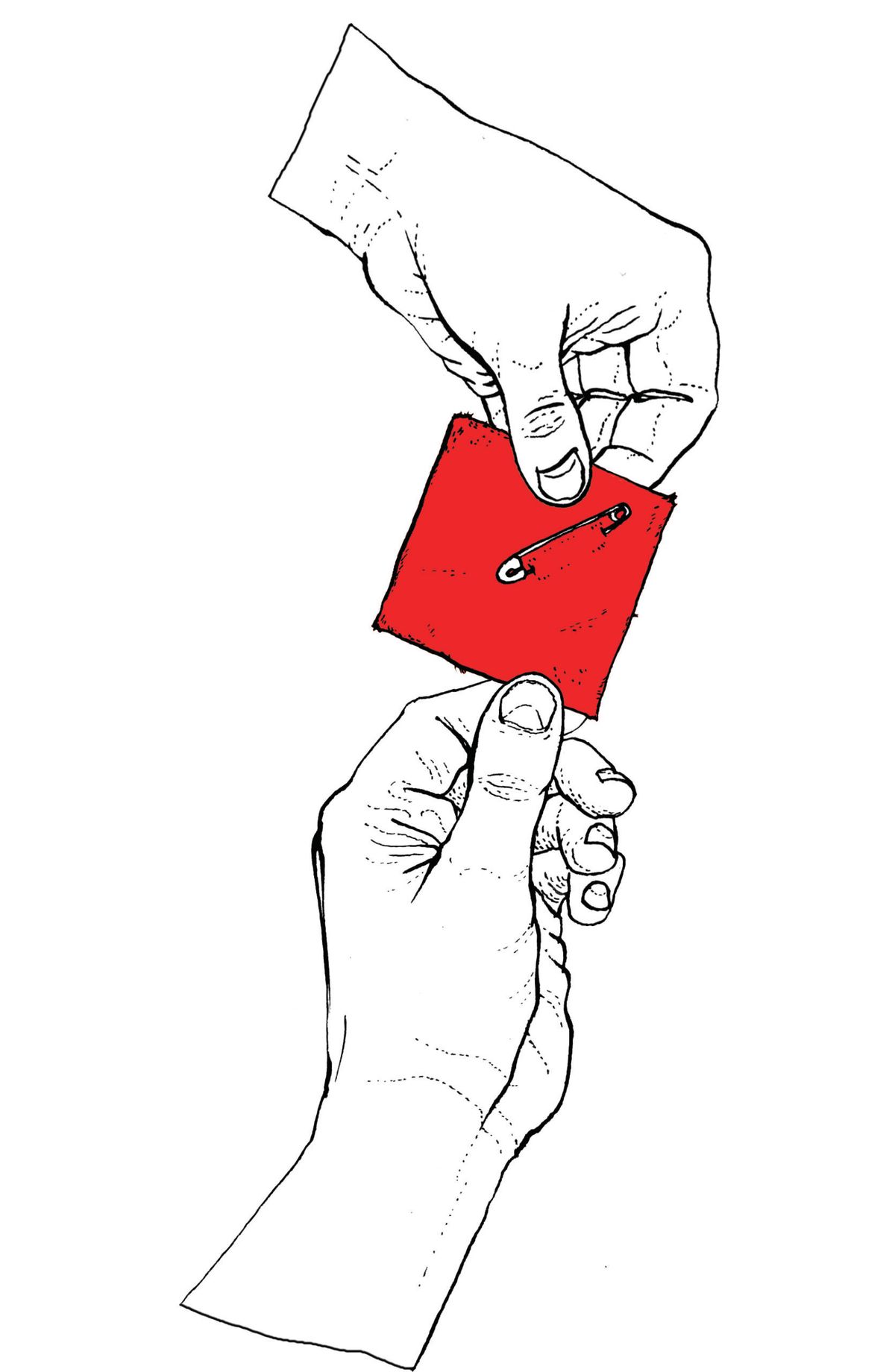
One recurring motif appeared everywhere, across banners, placards, leaflets and pinned to lapels: a simple red square.
The red square became the defining symbol of the student strike. It originated as a play on words—"carrément dans la rouge" or "squarely in debt"—several years before, first appearing around 2005. But the red square symbol took on a life of its own that spring. It was easily replicated and could be cut from any red material and pinned to clothing as a symbol of solidarity.
In May, faced with months of mass actions and unsuccessful but violent police efforts to repress the protests, Québec's legislative body adopted Bill 78, an emergency law aimed at forcibly ending the strike. Bill 78 imposed draconian restrictions on street demonstrations, in violation of Canadian constitutional rights and international human rights law. It threatened steep fees on students, student associations, and unions that disrupted classes, and it imposed a requirement that organizers apply in advance before mobilizing a group of more than 50 people.
This further radicalized many students and drew in new layers of support for the strike from the wider community. The proposed tuition hikes and then the protest repression by the province and police tapped into broad-based outrage over the state's abandonment of the public good through neoliberal policies, privatization of public services, and austerity and its anti-democratic clampdown on protest. As Marie-Ève Charron and Thérèse St-Gelais recall:
An impressive number of smaller anti-[tuition] hike groups were also formed, lending a popular, social aspect to the student movement. These included Profs against the hike, Parents against the hike, Retirees against the hike, Artists against the hike, Crayons against the hike, and related groups such as 'Tête blanche carré rouge' (grey hair red square), 'Mère solidaires et en colère' (angry mothers in solidarity), and neighbourhood groups like the Association populaire autonome de quartier. One of the most repeated slogans during this time was 'La grève est étudiante, mais la lutte est populaire' (the student strike is the people's struggle).
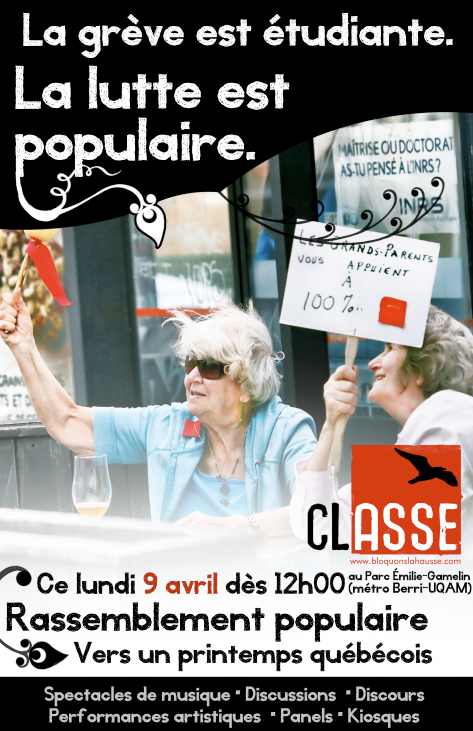
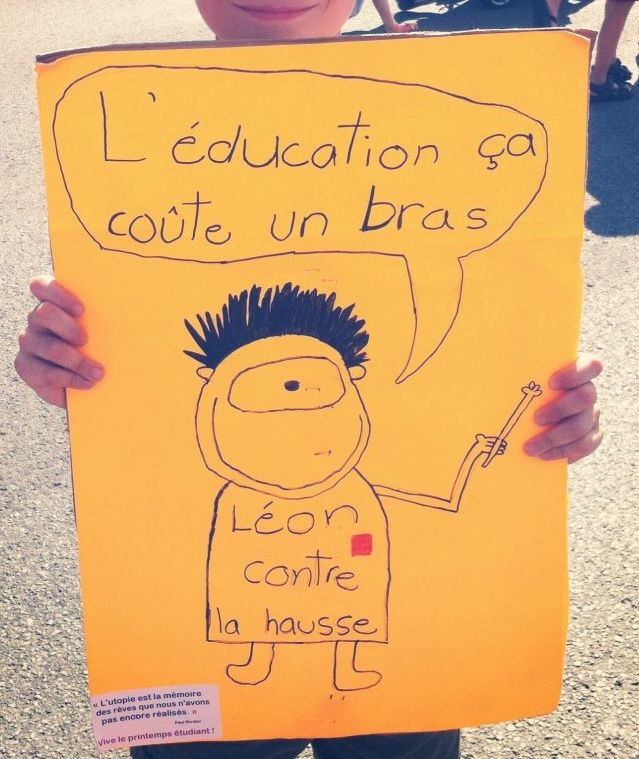
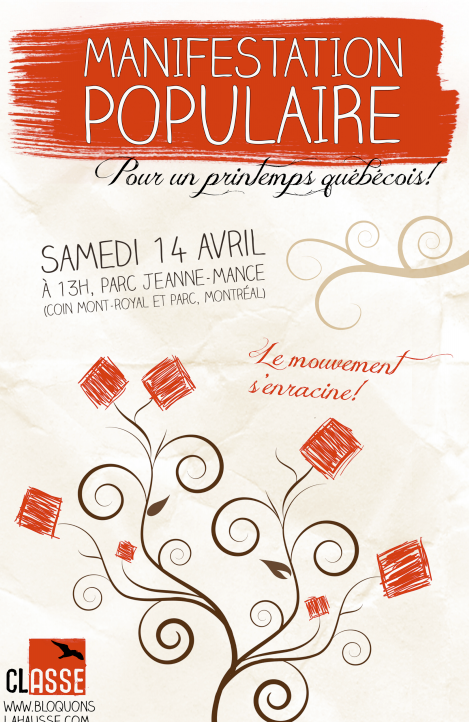
Now red squares were worn by anyone who supported the movement. The symbol was endlessly reworkable, and could be reimagined visually across banners, pamphlets, websites, clothing and political materials.
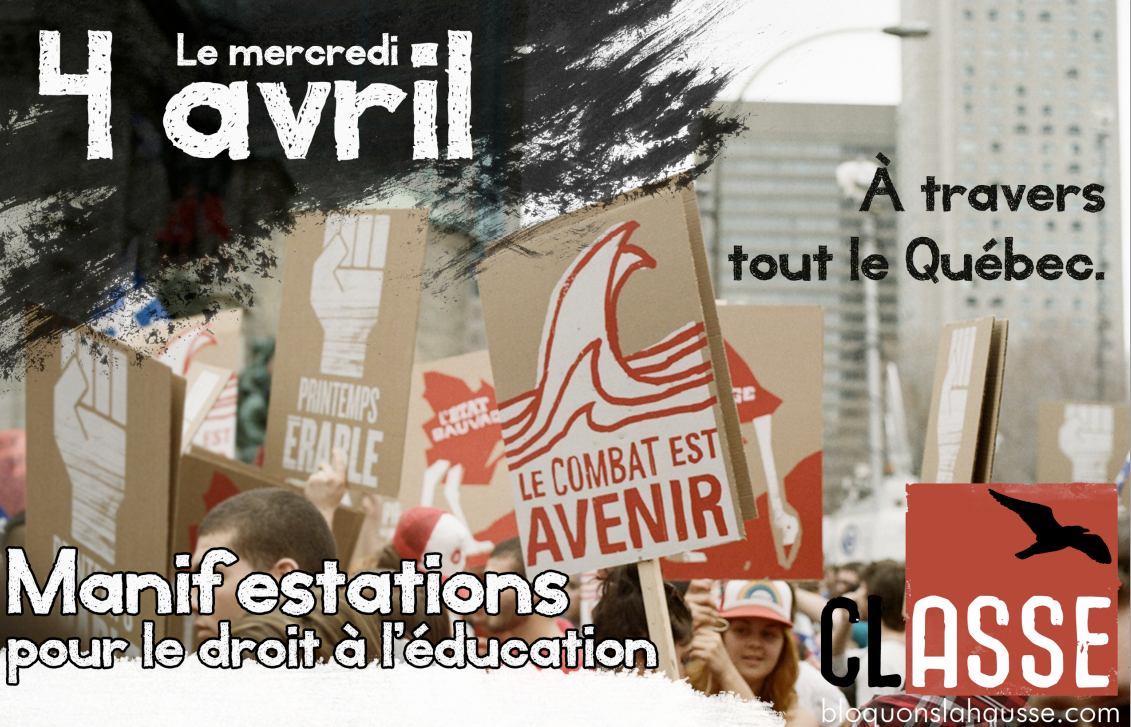
The strike was the result of years of behind-the-scenes planning and agitation on the part of student organizers like Savard and student associations and federations across Québec's universities and colleges, including the radical coalition CLASSÉ (Coalition large de l'Association pour une solidarité syndicale étudiante), formed by the syndicalist federation ASSÉ (Association pour une solidarité syndicale étudiante).
A Legacy of Strikes
Student activists drew on know-how, tactics, discourse, and networks, much of it rooted in Québec's storied history of student organizing modeled after labour unions, such as framing their mass action as a "strike." The strike against the tuition hike was the longest and likely the largest act of mass civil disobedience in Canadian history, with at least 168 protests based on reporting in English-language student newspapers alone.
The success of the 2012 strike owed much to a legacy of previous strikes stretching back to the 1960s, Savard says. An important factor in the strength and resilience of Québécois model is the centrality of the annual general assembly to student union organizing, he explains. These assemblies provide members with democratic control and active participation in the union's decision-making process. A series of smaller strikes and one-day actions throughout the 2000s also helped the student associations to exercise their muscles, gauge their strength, and mobilize for bigger actions down the line. By taking regular action, these organizations were also able to sustain their internal capacity by continually training new organizers, overcoming the pitfall of high-student turnover which can disempower student movements.
One throughline of both these historical protests, and the series of actions student unions took through the 2000s, was that the disruption of education can open up different modes and ways of learning, temporarily transforming social relations and allowing participants and supporters to reimagine everything from their classroom, to the world.
Creative Outpouring
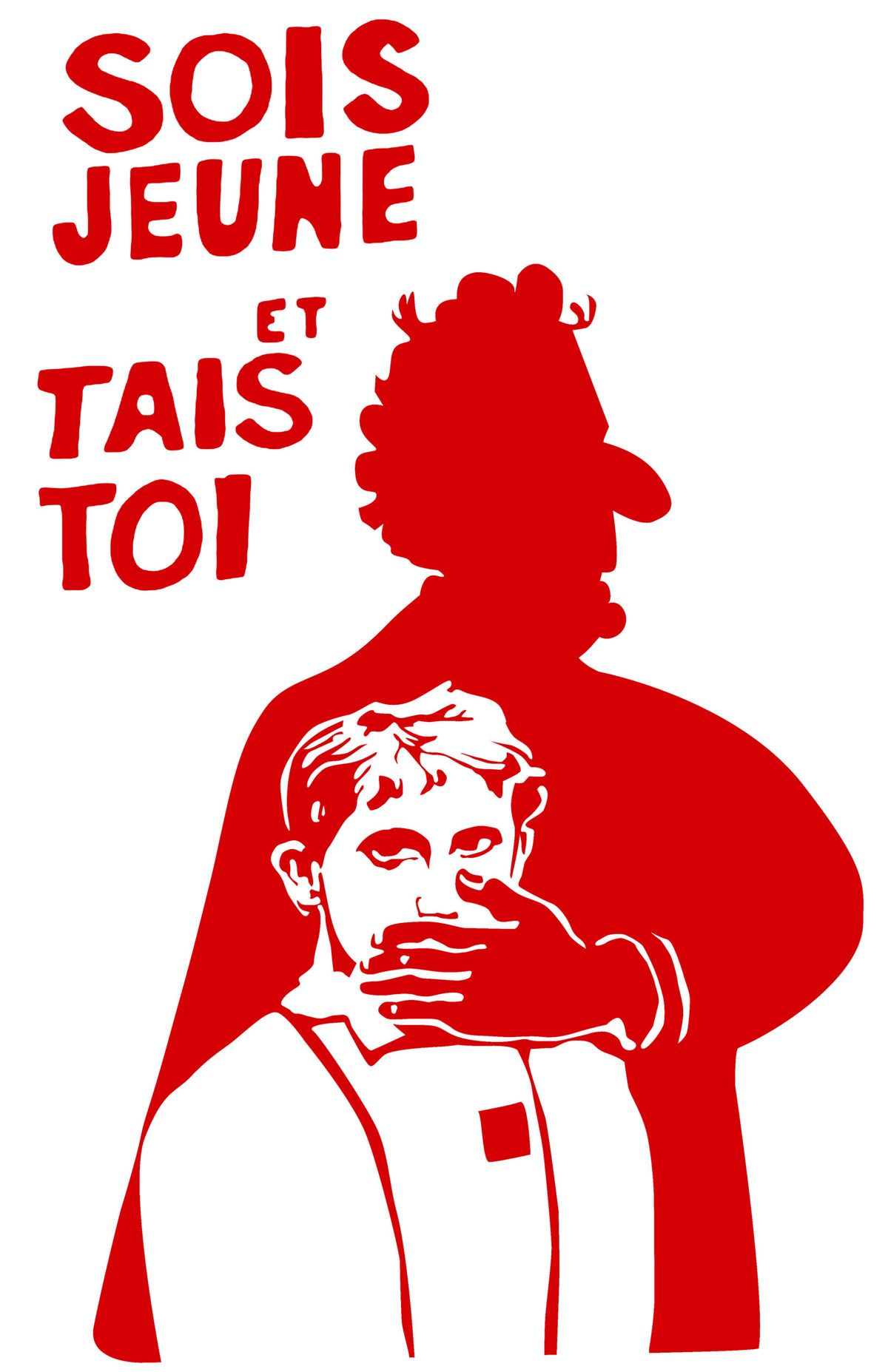
As Savard observed, once the strike started, the movement took on a life of its own. With this came a creative outpouring. Groups formed on their own to produce artwork in support of the strike, like École de la Montagne Rouge (The Red Mountain School), a collective of student artists from the graphic design department of the Université du Québec à Montréal (UQAM). Their work reimagined the red square in different ways: not only in graphics for posters and political cartoons, but even as a huge street installation that became part of the protests. Many of their works directly referenced the visual language, iconography, and slogans of the May 1968 student strike in Paris—indicative of the many ways that Québec student organizers have looked to the history of campus organizing in France for inspiration.
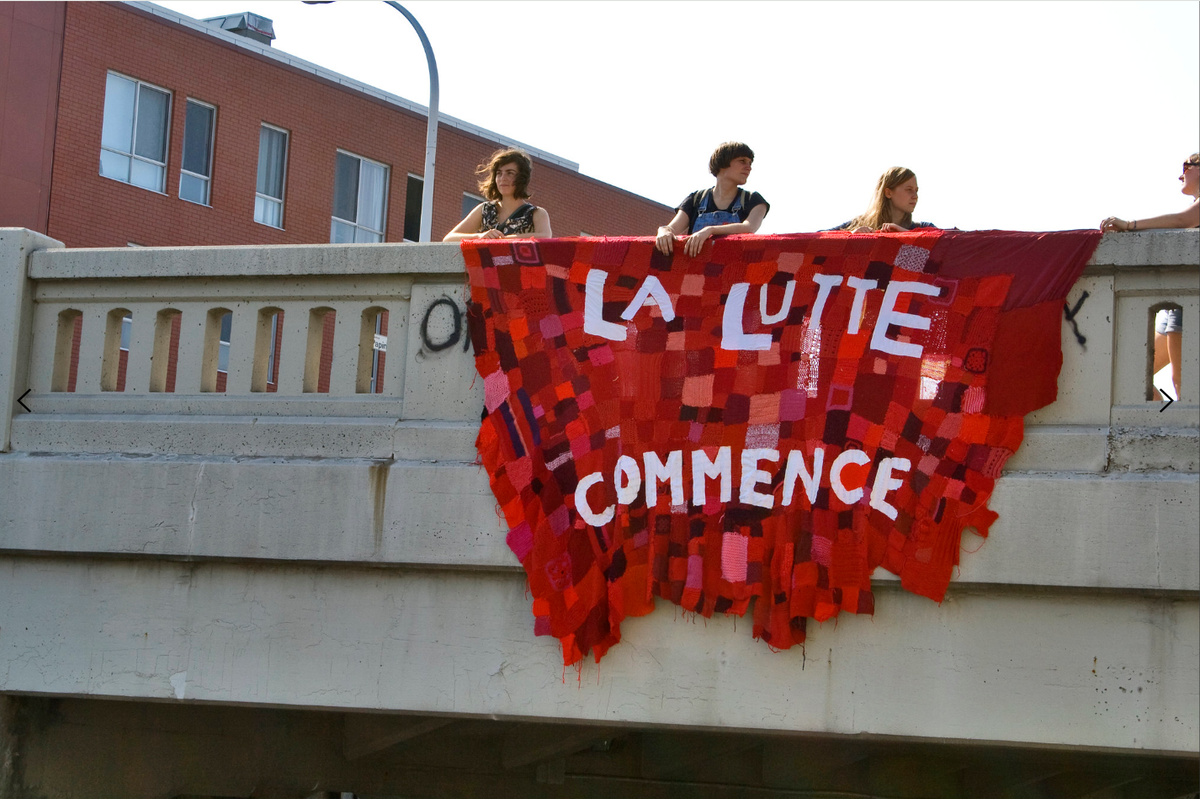
A "knitting-graffiti" collective, Maille à Part, created street installations and banners in textiles and knitted yarn. One of their pieces was an enormous banner constructed of hundreds of red squares made from different fabric, announcing La Lutte Commence (The Struggle Begins). They also knit sweaters for public statues in Montréal, complete with little red squares. The red square provided the movement with an emblem that could tie together its many various strands, both visually and symbolically.
Along with the red squares, art in many forms animated and united protesters during the strike. Musicians created bands that played fundraisers for the movement. There was a "dance your strike" group and a "people's choir" that brought music and rhythms to picket lines and demonstrations. A writing collective called Fermaille circulated poetry written during the strike. The group published the work online, distributed weekly booklets at demonstrations, and held workshops and poetry readings in the park. In issue #17, a poem by the writer u. gelin begins: "La colère rouge monte/ Les esprits s'embrasent" ("Red anger rises/Spirits ignite").
Students also came up with an innovative way to create every-day spectacles beyond large demonstrations. Theater students at UQAM created a "ligne rouge" (red line), whereby they would all dress in red and line up every morning at 8:30 am along the subway platform at Montréal's Jean-Talon Station, boarding and disembarking the train at every station until they got to school. The "Red Line Dancers" and "Theatre Struck Groups"—dance and theatre students from Concordia University—created public performances such as slow motion walks down the main thoroughfare of St. Catherine Street in Montréal, using the slogan: "Don't slow down our education."
Art has unique value for strikes, other actions, and the participants. Participants use it to show solidarity and build connections across disparate groups—in this case, across many different cities, campuses, labor unions, neighborhood associations, and beyond. Art constructs an aesthetic identity for a movement that helps people feel connected and included. An aesthetic identity helps to make a movement and its demands legible, both internally and externally, beyond just a sea of bodies in the street. This helps to anchor participants in a tumultuous political moment in their lives. And it sends a different kind of message than a slogan or a news write-up can, extending the movement's actions and demands beyond the protest action and making it part of the wider campus and city environment.
Creating art also can be a way of making participating in a movement more fun and more accessible. It opens up the kind of skills that can contribute. During the 2012 strike, students in different departments and programs came up with their own distinctive ways to contribute, some rooted in their creative-academic skills, like architecture, design, and theater. Even though they boycotted classes, they never stopped learning. The strike itself was a kind of artistic education.
The Power of the 2012 Strike
For many who took part in the 2012 strike, its scale and significance was profound. It felt like the outpouring of solidarity was about more than just a hike in tuition fees. On April 7, the 54th day of the strike, Gabriel Nadeau-Dubois, then a spokesperson for the student coalition CLASSÉ, addressed a crowd at the Monument-National Theatre Montréal:
Our strike is just a step, a stopping point along a path that is much, much longer. Our strike is already victorious because it enables us to see that path, the path of resistance. That is the real meaning of our strike. 250,000 people do not turn to the streets just because they don't want to pay $1,625 more for tuition. The meaning of our strike lies in the durée, in the revolt that follows tomorrow. This spring of 2012 we planted the seeds of a revolt that may not germinate for several years. But already we can say that the people of Québec are not asleep, nor are their youth.
The power of the strike ultimately forced the government's hand. In August 2012, Charest called a general election in which the handling of the strike and its demands was a key issue. He hoped that a "silent majority" would express its opinion on the hike in tuition fees. It was a bad gamble, and his party lost. Two weeks later, the new government led by the Parti Québécois cancelled the tuition fee increase and repealed Bill 78. The student strike, which had begun on February 13, officially ended on September 7.
The impact of the 2012 student strike lives on, informing student activists in Québec today, who continue to look back to that mass action as a guide and inspiration for organizing. The outpouring of artwork and creativity not only helped to energize the strike and connect participants in the moment. It allows later generations of activists to make sense of that mobilization and envision other futures.
A recurring slogan, throughout the strike, was: le combat est avenir (the fight is the future, the battle has just begun). The students and community activists understood this as a long struggle, in a long history of collective organizing. In 2013, the Fermaille collective published an anthology of the poems it had collected during the strike. At the end of the collection, the editors wrote: C'est fini pour nous, découragez-vous pas (It is finished for us, do not be discouraged). It was a message to the future: Our strike may have ended, but the seeds we planted are yours to nourish.
Takeaways for activists
- Sustained mass action is possible with long-term organization, especially existing organizations. Student associations and unions are a vital backbone of major long-term demonstrations or strikes. They are a crucial basis for democratic participation. They also provide representation in formal negotiations with the government, university administration, or other targets. Even though the student population has a high amount of turnover, these organizations can help maintain political consciousness over many years.
- Art can be a powerful tool for protest movements. The creation of an aesthetic sensibility linked to a particular movement helps build bonds of solidarity between groups, participants, and supporters. It also makes movement legible internally and externally and increases accessibility, allowing people with a range of skills to participate.
- Don't doubt the strength of a powerful, memetic symbol. During the strike, the red square was ever-present and a consistent symbol of solidarity and outrage. Find these and build your coalition with them in mind.
- When students can support mass action with their creative-academic skills—like theater, design, or dance—they never stop learning, even if classroom learning gets disrupted. And a protest itself can become an educational experience that opens up different modes of learning.