“You can’t pay your rent with prestige”
Tactics, trade-offs, and long-term leverage on the picket lines of the 2015 CUPE strike at the University of Toronto
James Nugent will never forget how it all began. “It’s a memory that will stay with me forever,” he says.
On the evening of February 27, 2015, around 1,000 graduate student teaching assistants, graduate course instructors, exam invigilators, and other academic staff at the University of Toronto packed themselves into Convocation Hall, a neoclassical domed amphitheater on the St. George campus. Nugent, then a PhD student in Geography, was one of them. All were members of Canadian Union of Public Employees (CUPE) 3902 Unit 1, and they were gathered to vote by secret ballot. The university administration had offered a last-minute 3 AM deal in hopes of avoiding a labor strike.
“There was this slight moment of silence before union leadership got up to recommend this agreement, and someone just yelled out: ‘Strike!’ And everyone erupted and cheered,” Nugent says. The deal offered by university administration was overwhelmingly voted down.
The strike began the following Monday, coordinated with a twin strike by CUPE 3903 at nearby York University. One of the key issues at play was wages for teaching assistants (TAs), but the finances were complex to explain to outsiders, making messaging difficult during the strike. Teaching assistants were guaranteed $15,000 CAD in funding annually, which worked out at $42 CAD an hour (appx. $33 USD at the time). That might seem high, but hours were capped at 160 hours in an academic year. This made it difficult for teaching assistants to earn above a poverty wage. The university was refusing to budge on this funding package. Meanwhile, rents in Toronto were rising and the cost of living was skyrocketing.
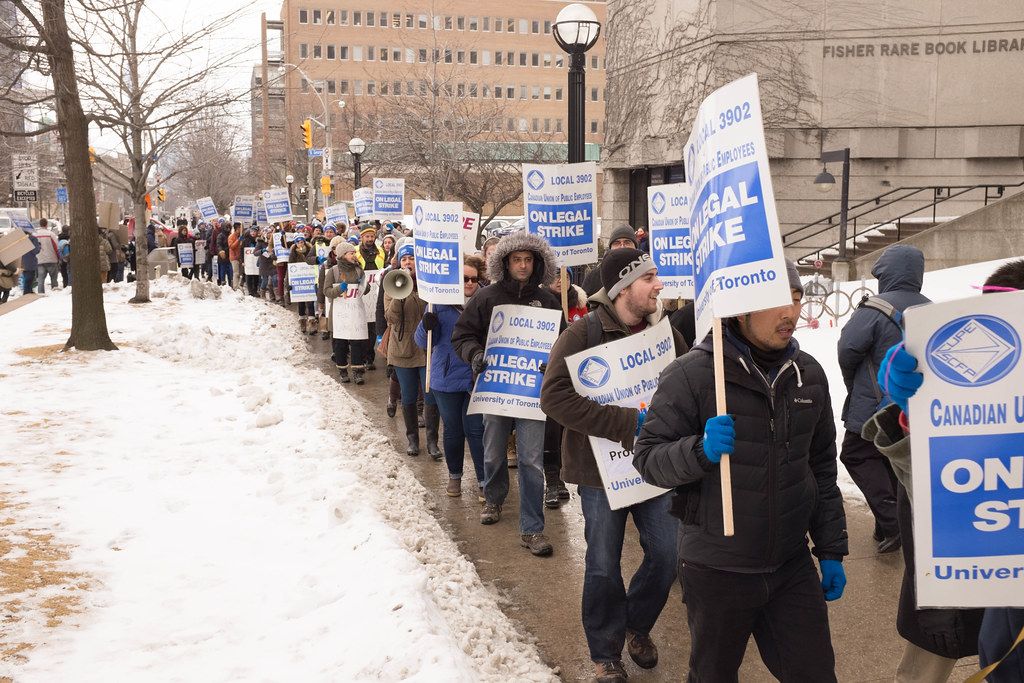
“Members are tired of living in poverty and precarity,” Erin Black, then CUPE 3902 chair, told the University of Toronto St. George student newspaper The Varsity. “The package has not increased since 2008 and, as costs of living have increased, this means a decline in real income. $15,000 is 35 per cent below the poverty line for the city of Toronto.”
Lama Mourad, then a teaching assistant, told The Varsity she found the university’s proposal insulting. “Under these conditions, where we have to work an excessive amount of hours to be able to live at the poverty line, we won’t be able to teach students well or dedicate time to our research,” she said.
Nugent was one of 6,000 TAs and other academic staff members represented by CUPE 3902, who spent a month on the picket line throughout that freezing cold March. He became deeply involved, publishing a rank-and-file strike bulletin that was distributed among workers. For Nugent, standing on a picketline for a month was itself a profound experience, personally and academically.
“It’s funny that through a strike, you actually get the grad moment that you envision coming into grad school,” he says. “On the line, you start to have informal conversations about each other’s research and what you’re interested in. You get a lot of time to talk about what’s going on and what people are up to. It was exciting, and in some ways it fulfilled an important academic role in terms of helping us get to know one another.”
Adam Zendel, also a PhD student in geography at the time, was a picket captain during the strike. He says the timing of the strike was chosen extremely strategically by the union, near the end of the academic year. The end of the semester is the busiest time for TA grading. In the spring, undergraduate students are eager to finish their courses, and many are planning to graduate. The timing made it hard for the university to take measures to prevent upheaval.
“A March strike is a sweet spot,” Zendel says. “It maximizes pressure and disruption and prevents the university from doing any continuity planning.”
He also remembers the challenge of effectively picketing a porous urban campus.
“It’s an incredibly challenging campus to lock down,” he says. “We realized that no amount of mobilization was going to shut down the campus properly, so we had to come up with other ideas on the fly.” They stayed flexible, identifying pressure points such as the locations where unionized postal workers made their deliveries to the university. “All we had to do was go and find the loading dock and put three people right there, and there’d be no mail there for a week,” Zendel says.
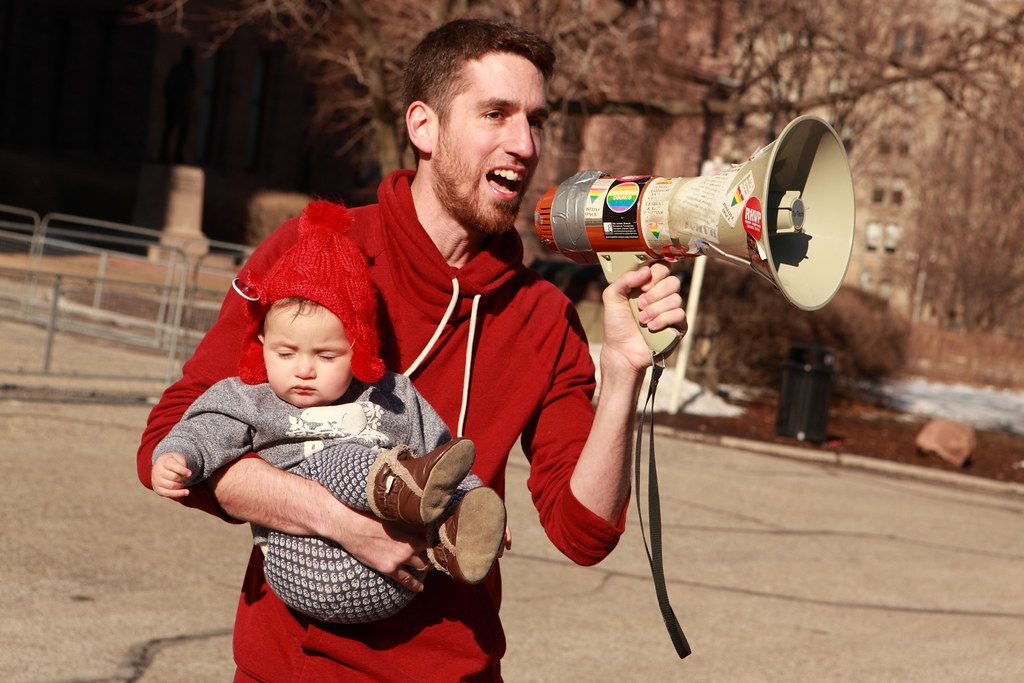
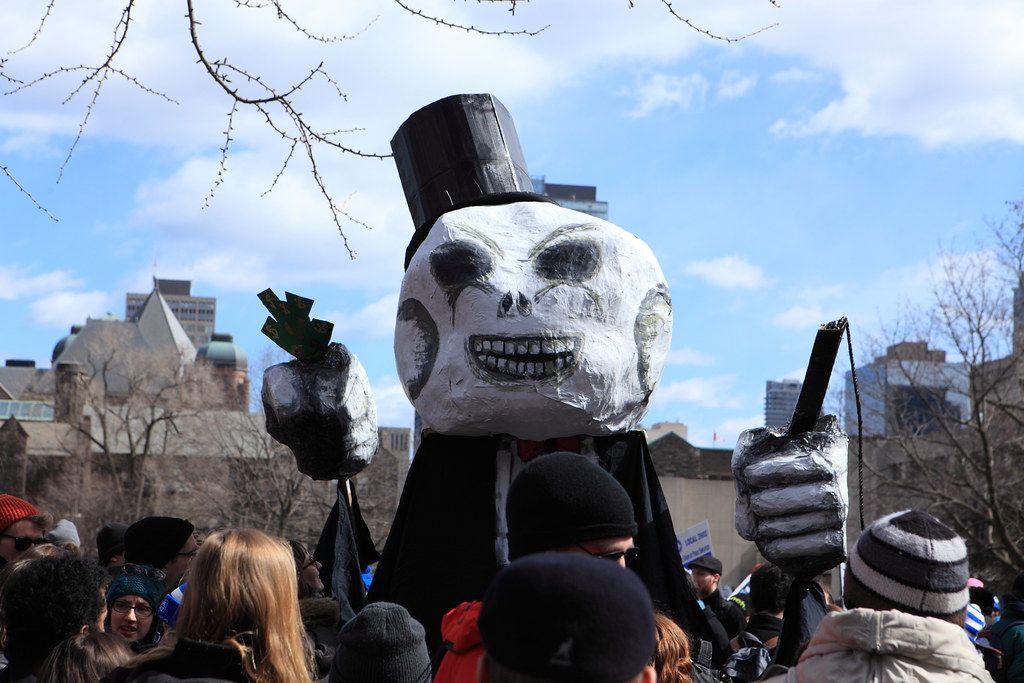
“One of the more provocative pickets we had was the ‘baby picket’,” he says. “One of the things we were asking for was childcare benefits. So all of the parents in the union and caregivers of all sorts showed up with their strollers, and we picketed around King’s College Circle,” at the center of campus. Other moments stick out in Zendel’s memory, including songs, performances and giant puppets built by members of the theater and performance studies department that appeared at different picketlines. On another occasion, professors demonstrated in solidarity with strikers wearing full academic regalia.
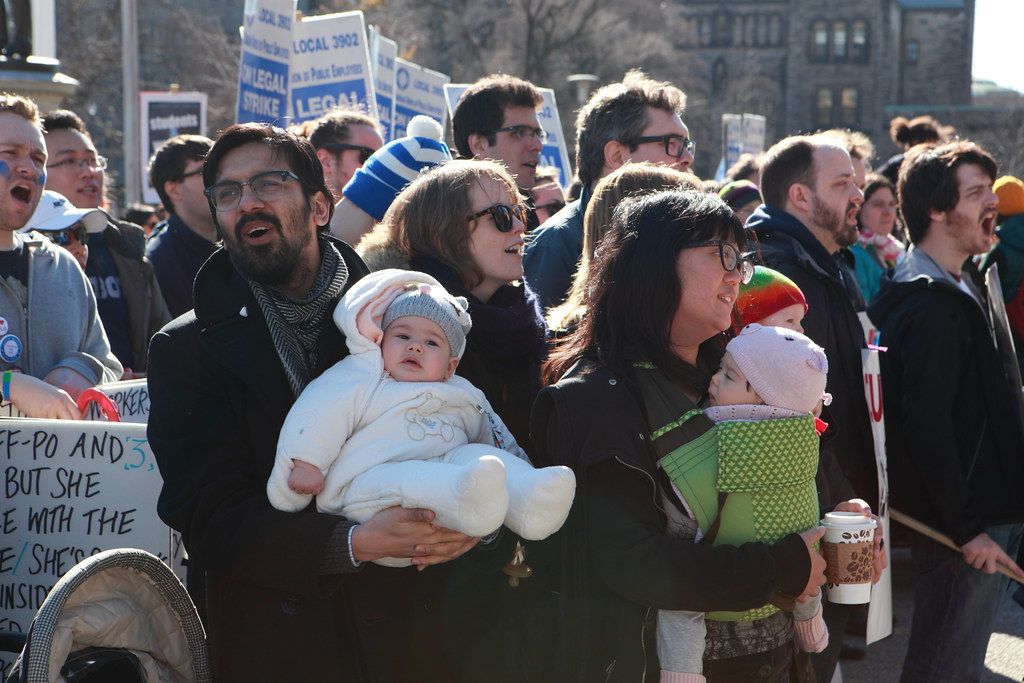
Student newspapers from the time highlight the importance of student solidarity with the strike. The University of Toronto Students’ Union, representing the undergraduate student body on the downtown campus, organized several student walk-outs during which large crowds gathered outside university offices in Simcoe Hall. “It is a symbolic gesture of strength and unity,” Brian Law, president of the Computer Science Graduate Student Benevolent Society, which represented computer science graduate students at the university, told The Varsity at a March 25 walkout.
Undergraduates also wore pins and CUPE 3902 hats around campus in support of the strike, and they joined picket lines in solidarity.
“We pay thousands of dollars each year to the University of Toronto, expecting that some of it go to those who teach us and we expect the university to be held to account for not living up to this expectation,” read part of a letter written by a coalition of students in campus leadership positions, encouraging the unionized teaching assistants to vote against an agreement offered by the university.
Some students used the opportunity to make arguments about additional issues they saw as connected to the strike demands. Students at University of Toronto Scarborough organized a sit-in with support from CUPE 3902, outside their registrar’s office to protest “severe financial insecurity and unfair treatment of our TAs, the increase in tuition fees for domestic students, the unregulated tuition fees for international students, and the university’s investments in weapons’ manufacturers and fossil fuels.” They held signs reading: “I <3 TAs,” “U of T Negotiate,” and “#WeAreNotYourBasicIncomeUnit.”
Despite support from the student body, solidarity from the faculty association and off-campus groups, and potential leverage from the concurrent York University campaign, the strike struggled to achieve its demands. At times, as the strike dragged on for weeks, it was challenging to keep morale up. “You can’t pay your rent or buy groceries with prestige,” Michael Collins, then a PhD candidate in English, told The Varsity.
The university remained intransigent on the basic funding package. In turn, the union voted to reject several agreements offered by the university. Finally, on Thursday, March 26, the members of CUPE 3902 Unit 1 voted to accept binding arbitration in their contract negotiations with the university and return to work the following day. This meant that both the union and the university ultimately agreed to abide by the decision of a third-party outside arbitrator.
For Nugent, the ending of the strike was bittersweet, especially since the arbitrator imposed an agreement that had already been rejected by members in a previous vote.
If there was one message he could pass on to student organizing today, it would be to recognize the limitations - as well as the value - of the formal structures of the labor movement.
“As much as they can be tools, they can also be limited,” Nugent says. “And at the end of the day, we need to be well organized at a grassroots level within our organizations and within our workplaces. That’s always where the strength comes from.”
But Nugent still maintains the strike had longer term impacts beyond its immediate outcome.
“Some people question the point of going on strike,” he says, “You can’t evaluate a strike based on what is won and not won in a particular strike, because you set the context for future negotiation. That can feel intangible. But it was a wake up call for [the university administration] and the funding package did improve significantly later on.”
“It wasn’t a victory,” Zendel agrees. “We did not win in many ways. But I think we won by being organized.” He went on to serve on the bargaining committee for the next round of negotiations which took place three years later, where the union won substantial increases in wages amongst other improvements in working conditions, like increased parental leave time. The power the union had shown during the strike “changed the tone” of later bargaining, Zendel says.
“It showed the seriousness of the strike, of that muscle being flexed,” he continues. “It shows we’re capable of responding that way, and it means that when we make demands at the table it can be met by proper action and response. Many unions in the world have never gone on strike, and the employers don’t take bargaining very seriously. A union capable of sustaining a four week strike shows strength, assertiveness and power. It’s what labor power is.”
The predictions by Nugent and Zendel were right. Following years of organizing by CUPE 3902 members and the University of Toronto Graduate Student Union, the administration announced in 2024 that it would increase the annual base funding package for PhD and SJD students to $40,000 CAD. While that new package had deep flaws - including no plan to give funding to departments to pay for the increase - this win demonstrates the power of collective action over the long term.
Takeaways for activists
- Think strategically about the timing of your action or strike. Certain times of year are more disruptive and make it more difficult for the university to organize to minimize the impact.
- Embrace creative tactics that grab media and public attention. During this strike, union activists used “baby pickets,” giant puppets, and academic dress to highlight specific issues, garner media attention and keep morale up.
- You may not win everything you desire during a protest, but that doesn’t mean the action was a failure. The disruption and pressure of collective organizing can move a university to make greater concessions down the line.