Inside a campus occupation, linking past and present
How Brandeis students drew on a long legacy of anti-racist student activism
When hundreds of Brandeis University students took over the Bernstein-Marcus Administrative Center on November 20, 2015, they were upholding a proud legacy of student organizing on their campus.
Forty-six years earlier, in January 1969, 70 Black students took over Ford Hall, then a university administration building, with a list of ten demands for racial justice on the Brandeis campus, including creation of an Afro-American Center, efforts to hire more Black faculty, and a guarantee of scholarships for Black students each year.
The students in 1969 renamed the building "Malcolm X University" and took over the central switchboard, answering calls with that new name. Then-university president Morris Abram negotiated with the students, and after 11 days the occupiers left with a promise that most of their demands would be fulfilled. The university subsequently created the Department of African and African-American Studies, one of the first departments of its kind in a wave of new Black studies programs created across the country in the 1960s and 70s, founded in response to organizing by students in the Black Power movement.
In 2015, the physical building of Ford Hall was gone, but its memory remained. The students who occupied the Bernstein-Marcus building drew explicit links between past and present, from their choice of an occupation as a tactic to their hashtags #FordHall2015, #FordHall1969, and #ConcernedStudent2015, spreading their message online. In a post about the inspirational history of the 1969 Ford Hall protest, student protestors wrote:
Our actions as #FordHall2015 are bred from similar injustices experienced by #FordHall1969, both on campus and in the society around us. [...] There is no one action we can call on to explain why we have begun this movement; rather, we have an endless list of injustices against our black humanity that explains why we are protesting when we have gone unheard and silenced for too long.
From Mizzou to Massachusetts
Protests at Brandeis had begun earlier that semester in solidarity with a high-profile campaign led by Black students at the University of Missouri, Columbia ("Mizzou") who called themselves Concerned Student 1950, taking their name from the year Black students were first admitted to the university. At Mizzou, the campaign against campus racism and the university's mishandling had forced the resignation of the University of Missouri system president, Tim Wolfe, just a few weeks before the Brandeis occupation. Much like students at Mizzou, Brandeis students had become frustrated at what they perceived as a lackluster response from their university president, Lisa Lynch.
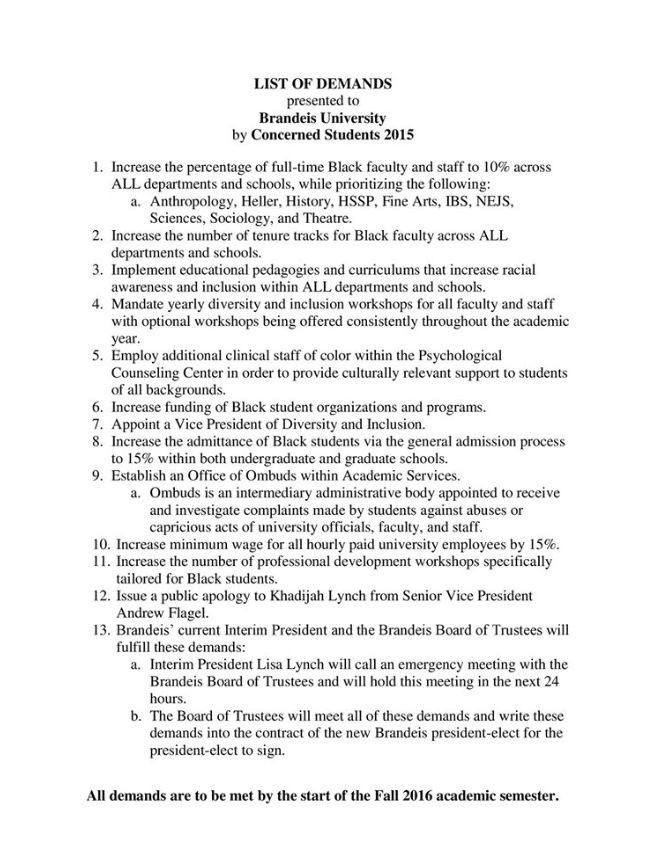
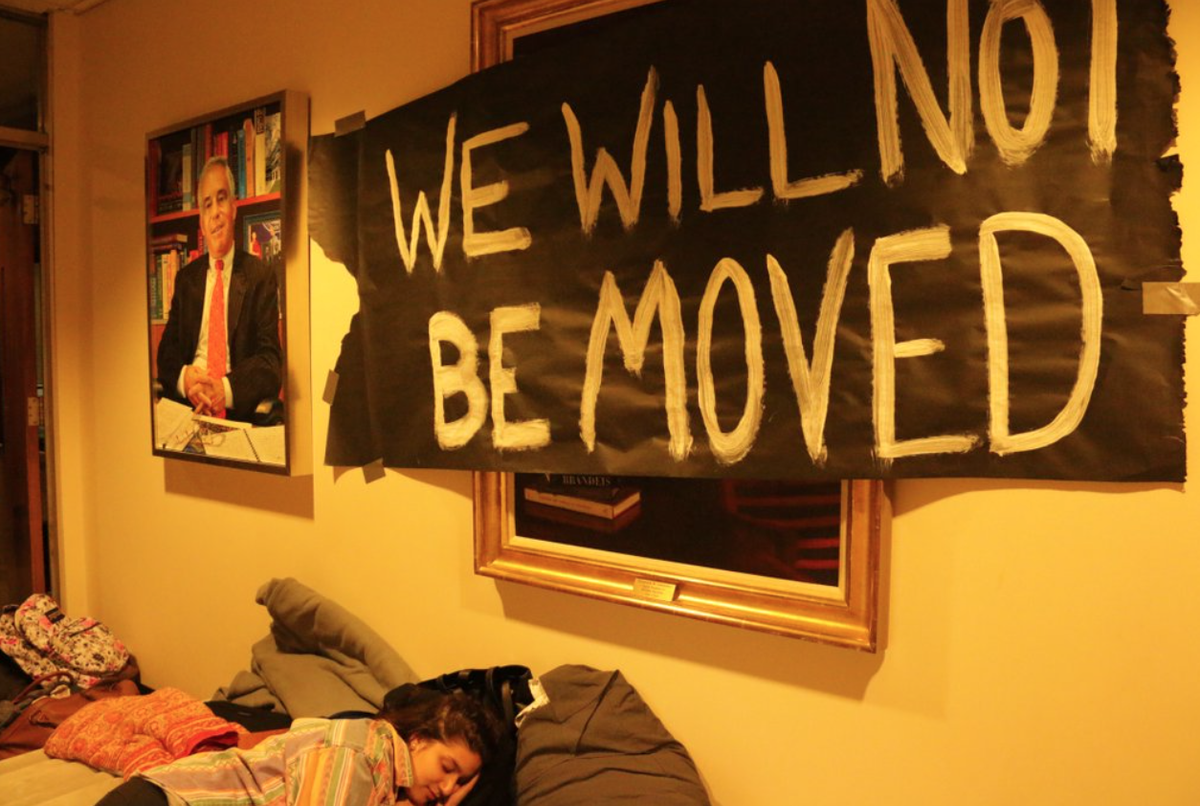
On November 19, Brandeis students issued a set of 13 demands to the president, calling for an increase in Black faculty, the implementation of racial awareness and inclusion in the curriculum, annual diversity workshops for faculty, and the appointment of a vice president of diversity and inclusion, among other demands. The following day, students marched to Lynch's office and began a sit-in with the intention of staying until their demands were met in full. After six hours of negotiating, protestors were not satisfied with the progress being made, and the #FordHall2015 occupation began, lasting for 12 days, into early December.
"As a University we have failed," Brandeis students wrote in the introduction to their demands. "We have failed our Black students. We have failed our Black professors. We have failed our Black staff members. We have failed our Black community. We, as a university, must not continue to claim ignorance of said failures. Black students across the nation are standing up against racial injustice on their campuses. We, as concerned students, need our university to stand with us and to work with us on addressing issues of injustice, as they unfold on our own campus."
New media, new narratives
The #FordHall2015 student activists understood that their occupation needed a public narrative. They produced their own account of events on Twitter, Facebook, and Medium, where they published videos, statements and updates.
On November 23, the occupation's Twitter account released several videos interviewing students about why they were participating in the protest.
"I am Ford Hall 2015 because being safe and represented at school should not be a privilege," said one student, raising a slogan that nodded back to the "I, Too, Am Harvard" campaign that ran the previous year by Black students at Harvard University, decrying problems of marginalization and stereotyping at the elite university.
"I am Ford Hall 2015 because our narratives need to be told, the university needs to be kept accountable for taking care of minority students, specifically Black students, and I am Ford Hall 2015 because this has been done before and can be done again," said another.
"Brandeis capitalizes on the idea of truth and social transformation as a fiscal framework to lure in students and more funding," wrote Brontë Velez, a participant in the protest, on Medium. Brontë highlighted demonstrators' frustration with the gap between the university's image and its reality. "Brandeis is not interested in living, enacting, and systematizing the truth they flaunt on admissions pamphlets. We wish their policies reflected their love for Black students as much as the front page of their website does."
Sustaining an occupation
Alex Montgomery, who was then a graduate student in public policy, recalls that the majority of participants in the sit-in were undergraduates, many of them women, who collectively managed everything from press releases to negotiations to access to fresh water.
He says the occupiers divided up tasks to allow the sit-in to keep going. Some handled carework like cooking and locating clean water, while others organized direct actions to keep momentum going. Some served on a small negotiating team tasked with speaking directly to the university administration about the protesters' demands, while others handled social media and external communications. Collectively, the #FordHall2015 activists formulated an entire syllabus for those interested in the protest and its motivations, including readings from Audre Lorde and Teju Cole.
The occupation was also visited by outside supporters, including the esteemed local civil rights activist Miniard Culpepper. The student organizers' savvy social media game attracted the attention of the press, getting the occupation write-ups in the Boston Globe and on CBS.
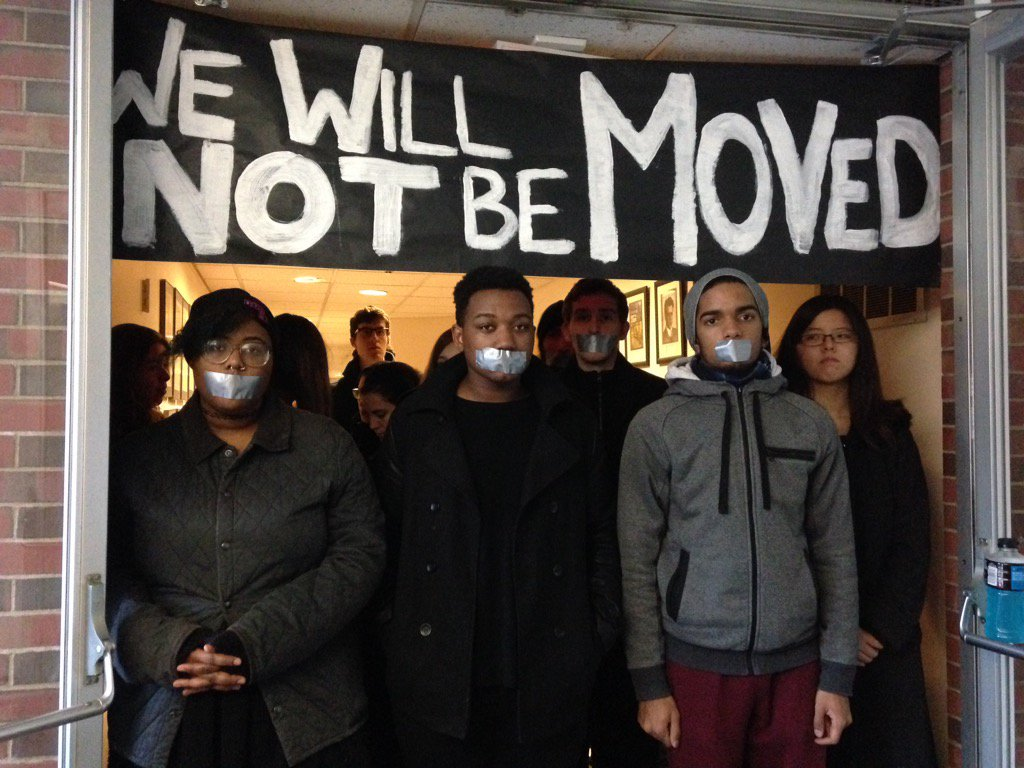
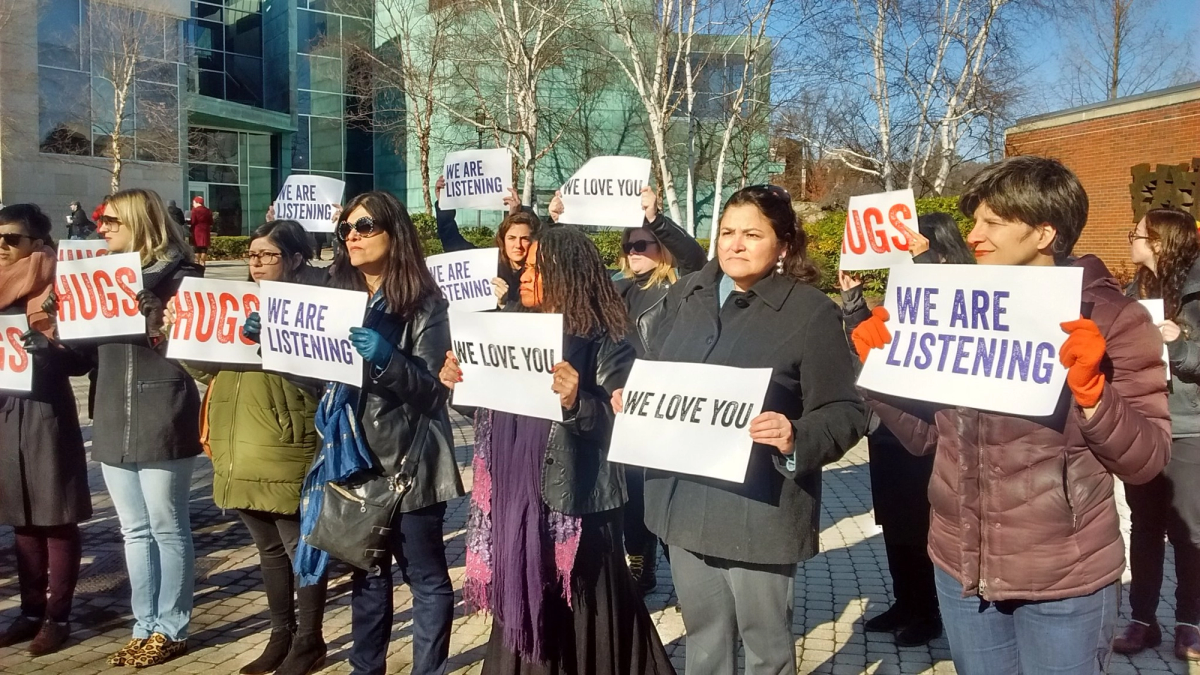
Brandeis professor Anita Hill, known for boldly speaking truth to injustice on the national stage, visited the occupation. Other faculty, particularly those from the African and Afro-American Studies Department, issued statements and showed up to support the demonstration. For Montgomery, this was particularly powerful. "The faculty came and they were holding signs in front of the windows saying, 'We support you. We love you. Keep going'", Montgomery says. "And I remember after seeing that, I broke down."
As the occupation continued, the American Thanksgiving break rapidly approached. It appeared that the sit-in might falter as people departed campus to see their families. But a group of students remained. Montgomery was among them. He remembers gathering with other protesters who had stayed on for an occupation Friendsgiving. "We all had a great meal. We fellowshipped. We went around and shared what we were thankful for."
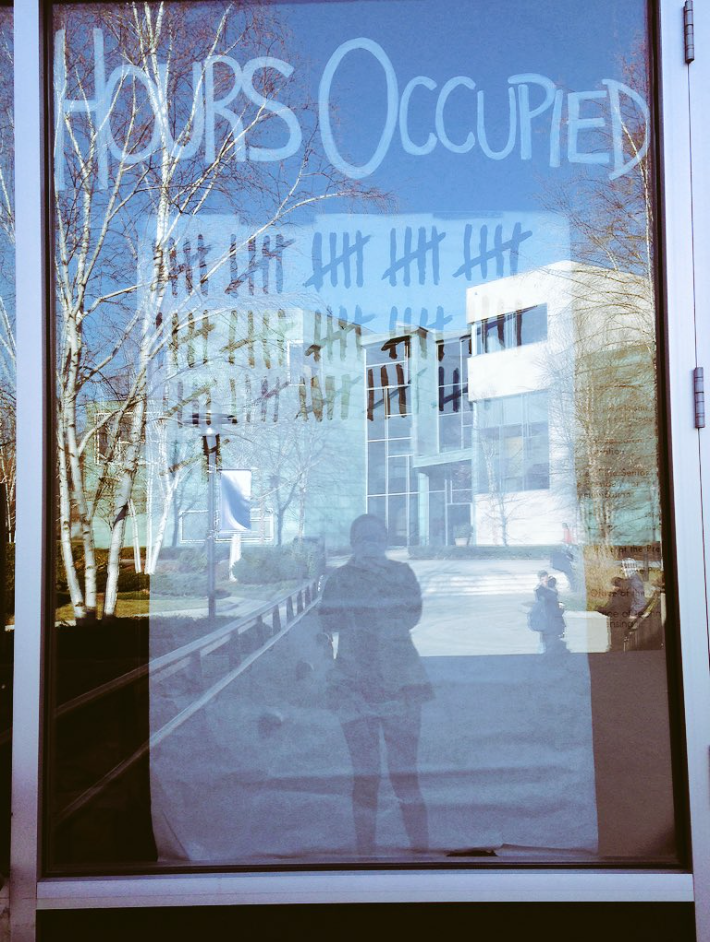
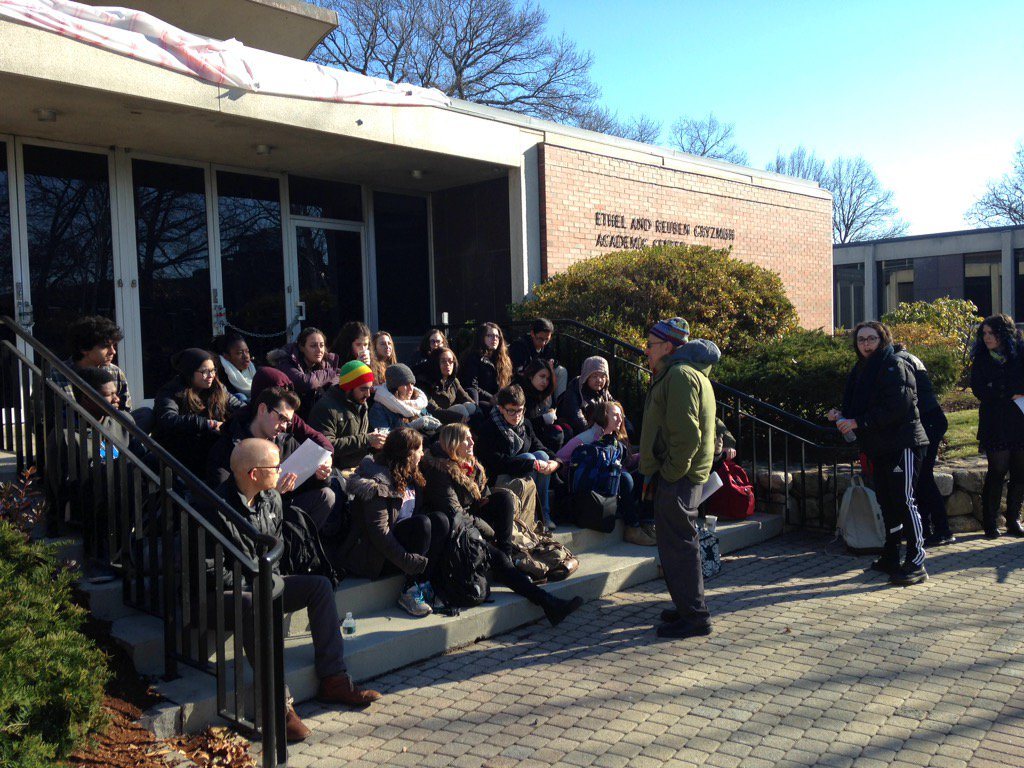
Faculty and supporters also continued to rally around the protest. Some professors moved their classes to the steps of the Bernstein-Marcus Administrative Center in solidarity with the occupiers. Graduate students volunteered their time at the occupation, offering to teach on everything from degrowth economics to intersectionality to health and racism.
What it means to win
Finally, on December 1, the protestors published a Medium blog entitled "We Believe That We Have Won". Earlier that day, the university administration had issued a Draft Implementation Plan that addressed the 13 demands.
"Over 200 Brandeis students, faculty, staff, and supporters congregated in front of the Bernstein-Marcus Administrative building to hear the Implementation Plan read aloud," demonstrators wrote on the #FordHall2015 blog. "We are overjoyed to pave the way for future Brandeis students and hope that our actions are inspirations to other university students demanding a positive change."
Reflecting on the impact of the occupation, Montgomery says the protest encouraged the university to formalize antiracism at an institutional level, particularly through the appointment of a vice president of diversity and inclusion, which was a student demand. "I'd like to think that 2015 at least expedited [that appointment], if not directly inspired the decision to go ahead and move forward with it," he said. Protestors also demanded a data-tracking dashboard that would allow students and supporters to monitor the university's progress with hiring and admissions. The university administration ultimately created that dashboard, housed in the new DEI division.
A year after the occupation ended, students affiliated with the protest helped found the Brandeis BLK Archives Collective. Their archiving work helps to create continuity amid turnover in the student body, so that Ford Hall 2015 can become Ford Hall 1969 for another generation.
As that site explains, "Wanting to maintain autonomy over the way the narrative of their labor would be cataloged and employed by the university, Ford Hall 2015 participants began working with Brandeis University Library Archives & Special Collections to explore the archival process and question how Black lives can be archived in a non-exploitative way." The group created an "Archive Assistant Student Liaison" role lasting one year, enabling a student interested in intermediary work between the BLK Archives Collective and undergraduate populations to work on the project with a university archivist. The site includes an annotated Black history at the university, a commemoration of Ford Hall 1969, and an account of Third World solidarities and student organizing in the 1970s.
And the student organizing momentum did not end on December 1, 2015. The following day, inspired by #FordHall2015, another group of students, the Brandeis Asian American Task Force (BAATF) issued its own demands for the establishment of an Asian American Studies Department. They were supported by the students of #FordHall2015.
Linking past and present
In 1970, just one year after the Ford Hall occupation of 1969, white students affiliated with Students for A Democratic Society (SDS) at Brandeis conducted another sit-in, this time in the Gryzmish administrative building, to pressure the administration to address the demands they made at Ford Hall more quickly. Their statement is a reminder of how the struggle to achieve a movement's goals doesn't end when a single protest does.
"We must not allow [the 1969 Ford Hall occupation] to be defined as an 11-day crisis which was peacefully ended," their statement read in 1970. "The crisis of blacks in America is 400 years old. The crisis at Brandeis will not be over until a black person can receive an education here, relevant to his needs and the needs of his community."
Just as their predecessors did not stop after the original Ford Hall occupation, the #FordHall2015 students continued mobilizing to fight racism at Brandeis and beyond.
In September 2016, almost a year after the Ford Hall occupation, over 100 students and community members marched, rallied, and held a die-in on the Brandeis campus, following the police shooting of Terence Crutcher, an unarmed Black man in Tulsa, Oklahoma. As reported in The Justice, the independent student newspaper on campus, many held signs: "I am black Brandeis" and "I am #FordHall."
Nyah Macklin, one of the #FordHall2015 negotiators, addressed the crowd at the rally, criticizing the policing of Black bodies and calling on anti-racist allies to mobilize beyond social media. "The riot is the language of the unheard, and we are all comrades in this war. So mourn," Macklin said. "And let this move you." Their protest ended with a circle and a hymn, chanting "Ancestors watching, I know they're watching. Ancestors watching, I know. I know."
Takeaways for activists
- Reaching into the history of your campus itself allows you to identify prior legacies of student organizing. Don't allow these histories to live only in the past—they can inform present day movements in an explicit way.
- Producing your own media is powerful, but it's also important to archive your media. There can be a problem of "link rot" around online resources, especially since we don't control the platforms we use and platforms frequently change or disappear (Twitter doesn't exist in the same way it did in 2015, for example). Think about how you might store your media for the next generation of campus activists.
- Some great resources for online archiving include the Wayback Machine/Internet Archive. Campus librarians are also a great resource—they have areas of specialization that can be counter-institutional, and can enable activists and organizers to tell and document university history. This can lead to impactful projects, like establishing an official archive or curating an exhibit on radical campus histories that center student activists' perspective.