Design and Methods
How we built HiPED
For details, see our Socius article.
Higher Ed Protest Event Dataset (HiPED) is a unique collection of data on higher education protests in the U.S. and Canada. HiPED contains 5,572 protests involving 543 U.S. and Canadian universities and colleges between January 2012 and June 2018. “Higher ed protests” include on-campus protests and also off-campus protests that focus on higher education. HiPED also contains data on how university administrators and police managed protest activism (for more than 30% of these protests).
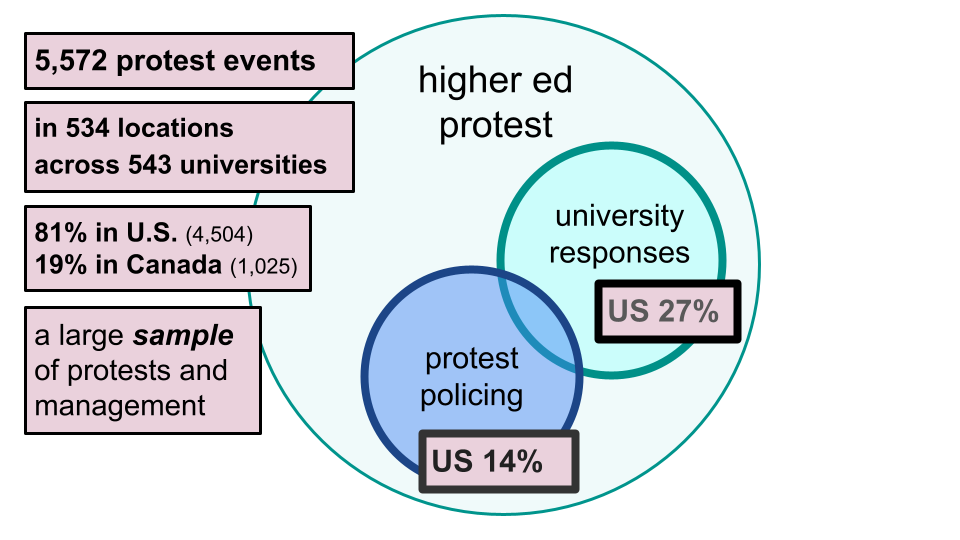
HiPED is a random sample — meaning, it’s a set of all the higher ed protests that happened in this time period. Because it’s a very large sample, created through a rigorous, detail-oriented research process, it provides a trusted source of information on large-scale patterns and specific protests. And because it’s random, we have a good sense that it reflects broader overall protests of the period.
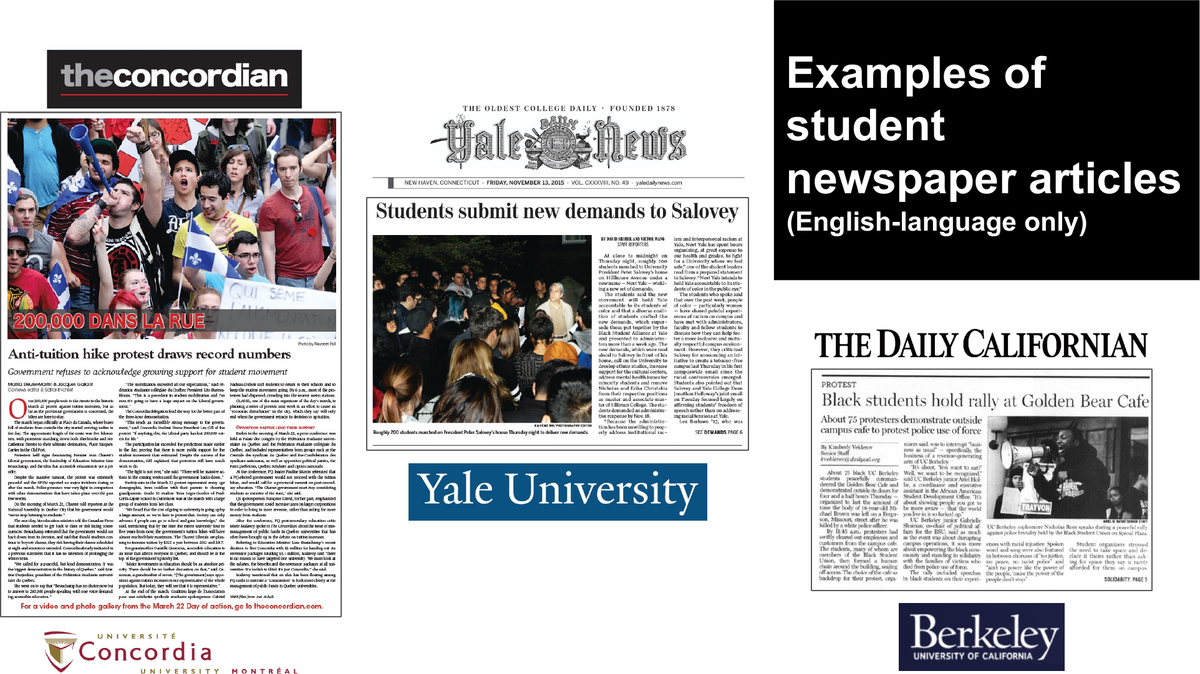
All the information in the dataset comes from over 16,000 articles in 605 English-language student newspapers which we gathered from a wire service called University Wire.
Our team used a combination of machine learning and hand coding to construct HiPED. Note that while we used “machine learning” we didn’t use “AI” like large language models. It took us eight years to create HiPED, with a team of 28 research assistants. We followed the tradition of protest event analysis, which counts protests and records key details, and we added many innovations.
The code for MPEDS, the MPEDS Annotation Interface, and our analysis can be found at github.com/MPEDS/mpeds, github.com/MPEDS/mpeds-coder, and github.com/MPEDS/protests-analysis, respectively.
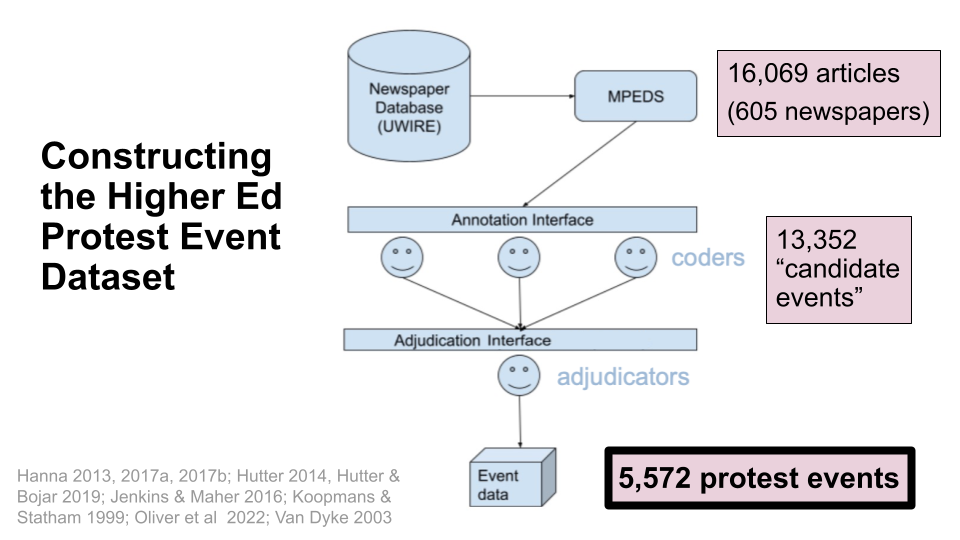
This careful coding generated our final set of 5,572 protests. Each protest record includes important information like the organizations leading the protests, what issues they were protesting over, and how big the protest was. But it also includes information on how university administrations and/or police responded, from praising free speech to making arrests.
Throughout, we took many measures to ensure high accuracy. These included months-long RA training, detailed feedback on RAs’ coding, double-coding, and reviews of coding quality using a data dashboard.
Funders
This work was only possible with funding from scientific funding bodies from the U.S. and Canadian governments (the National Science Foundation and the Social Science and Humanities Research Council, respectively), the Distributed AI Research Institute, and the University of Toronto.