“Black students on this campus feel uncomfortable every day.”
How students confronted historic symbols of white supremacy on their campuses
In October 2015, Dominique Scott, a junior at the University of Mississippi, sat on the steps of the Lyceum, the oldest building on campus, and looked up at the red, white and blue Mississippi state flag flying above. The Confederate battle emblem was embedded in its upper lefthand corner.
"I'm trying to be fearless as possible," Scott told The Daily Mississippian. "I'm not gonna to lie, I'm absolutely terrified."
Scott was attending a university NAACP-sponsored rally to remove the state flag on campus. As a crowd of several hundred students and faculty gathered holding signs reading, "This is our University too," "#whataboutus?," "I am more than a flag," and "Straight outta Patience,” Scott rose to speak.
She shared a personal story about her decision to attend Ole Miss, despite her trepidation due to its history of racial discrimination and violence. Instead, she told the crowd, she’d found an accepting community. Now, Scott argued, continuing to embrace the Confederate battle flag - a flagrant symbol of white supremacy - bolstered the racist culture she had expected to find. It also perpetuated stereotypes of both the university and the state as hateful toward Black people.
In a turn of events that demonstrates just how hostile the campus environment was for students of color, after the rally had dispersed, another group gathered on the steps of Fulton Chapel. This time it was a pro-flag protest organized by nearly a dozen members of the International Keystone Knights, an openly white supremacist Klu Klux Klan splinter group, who carried Confederate flags themselves, The Daily Mississippian reported. One counterprotester with a swastika and KKK tattoos, Shaun Winkler, told the student newspaper it would be a mistake for the university to remove the state flag. “Black lives don’t matter,” Winkler said.
Later that month, the university lowered the state flag and placed it in an archive. And five years later, in the wake of protests surrounding the murder of George Floyd, Mississippian voters cast their ballots overwhelmingly in favor of adopting a new official state flag that did not contain the Confederate symbol.
A hateful past
Campus protests against the Mississippi state flag encapsulate trends that defined the wave of student-led activism against racist symbols in the 2010s, according to an interview with Caleb Dawson, one of the authors of a HiPED team article on the subject. In “Protesting the Presence of a Hateful Past,” Dawson and his co-authors Ellen Berrey, Alex Hanna, and Kendal Kandasamy identify distinct tactics used by anti-racist student campaigners across the United States and Canada as they challenged Confederate flags, statues, mascots, murals, names of buildings, and other campus symbolism.
One common protest tactic was to challenge symbols of “white superordination.” Such symbols “depict White authority and glorify whiteness as the top of a racial hierarchy,” the article argues. In Ole Miss alumna Scott’s case, the Confederate battle emblem glorified white Southerners’ brutal exploitation of enslaved Black people and the ongoing legacy of anti-Black hatred.
Protestors communicated their critiques and concerns by using “counternarratives” and “counterstories”–concepts based in Critical Race Theory, as the article explains. Activists created counternarratives to retell the history of the racist symbols on their campuses, pointing to their origins in enslavement, settler colonialism, and other oppressive systems. Counterstories, on the other hand, were more personal. Just as Scott addressed the crowd beneath the flagpole with a story about her own life experience, so many other protestors found power in sharing personal testimonies.
Another pattern was that students recognized the importance of targeting their university’s administration. They organized to hold university leaders accountable for the white supremacist symbolism on their campus.
While students mobilized against white supremacist symbols throughout the 2010s, there was a spike in demands to remove these symbols in fall 2015, as students at the University of Missouri, Columbia (Mizzou) and across the country organized a wave of anti-racist protests.
A past without chains
One example of how powerful and politicizing this activism could be, both for the speaker and the listeners, comes from students at Amherst College in Massachusetts. The month after Scott spoke in Oxford, Amherst students staged a three-day sit-in at Robert Frost Library, to protest racism on their own campus and show their solidarity with Black students at Mizzou.
During the Amherst sit-in, students of color shared their personal experiences, and activists crafted an 11-point list of demands to present to the college president, the Massachusetts Daily Collegian reported. These included a demand to replace the school’s unofficial mascot, Lord Jeffery Amherst. Students retold Amherst’s legacy not as a decorated, 18th-century commanding general of the British army in North America, but as an advocate for murdering Native Americans by distributing smallpox-infected blankets.
“Asking our peers, some of whom identify as Native American, to rally around a mascot who advocated the genocide of an entire nation of peoples is not something we can do,” the Association of Amherst Students wrote in a letter in The Amherst Student in October, 2015. “Amherst College deserves a mascot the entire community can rally around — one that reflects our present, anticipates our future and acknowledges our past without chaining us to it.”
Nariman Mostafavi, a graduate student from the University of Massachusetts, told the student newspaper that attending the sit-in had changed his understanding of race in the United States.
“Seeing the crying, the insecurity, people so seriously isolated that they were at the point of breaking down in front of their peers and being forced to take leaves for multiple semesters was really impactful," Mostafavi told the paper.
This creation of counterstories is significant, says Dawson, who describes it as a kind of “sense-making” that is linked to an oral tradition of “narrating the felt life of racism.”
This assertion of personal lived experience was also reflected in the slogans students used. In November 2015, Princeton students occupied the office of Christopher Eisgruber, the university president, to demand the removal of the name of Woodrow Wilson, a former U.S. President and former Princeton President, from programs and buildings. As U.S. President in the early 1900s, Wilson re-introduced racial segregation across the federal government, blocking Black workers’ access to better jobs. Holding megaphones, a group of about 200 students led by the Black Justice League chanted outside Nassau Hall: “We're here. We've been here. We ain't leaving. We are loved.”
The students organized the 6-hour sit-in after they became frustrated with what they saw as the university’s lack of response to their demands. "They talk about issues without talking about the issue," organizer Asanni York told the Daily Princetonian. "They stray away from making statements that make bold claims because they don't want to make some people uncomfortable. But black students on this campus feel uncomfortable every day."
Trust Kupupika, a member of the Black Justice League, said Eisgruber had spoken with the students about their demands, but that “he didn’t see a problem in having students of color being forced to get a degree, or eat dinner or lunch or live in a place that’s named after a racist.”
Forrest’s funeral
Some protests employed theatrical flair. In November 2015, students at Middle Tennessee State University gathered in support of renaming Forrest Hall, a campus building named in honor of the Confederate General Nathan Bedford Forrest, who was also an enslaver and a Grand Wizard of the Klu Klux Klan.
Students arrived on campus carrying a black coffin and an effigy of Forrest. They placed the coffin on the front steps of Forrest Hall, then put the “body” inside. Their action targeted the Forrest Hall Task Force, which the university had formed after months of pressure that included petitions, marches, and demonstrations. Composed of students, faculty and community leaders, the task force was responsible for making a recommendation on the building’s name to university president Sidney McPhee.
Protesting Forrest Hall, 2015–2016
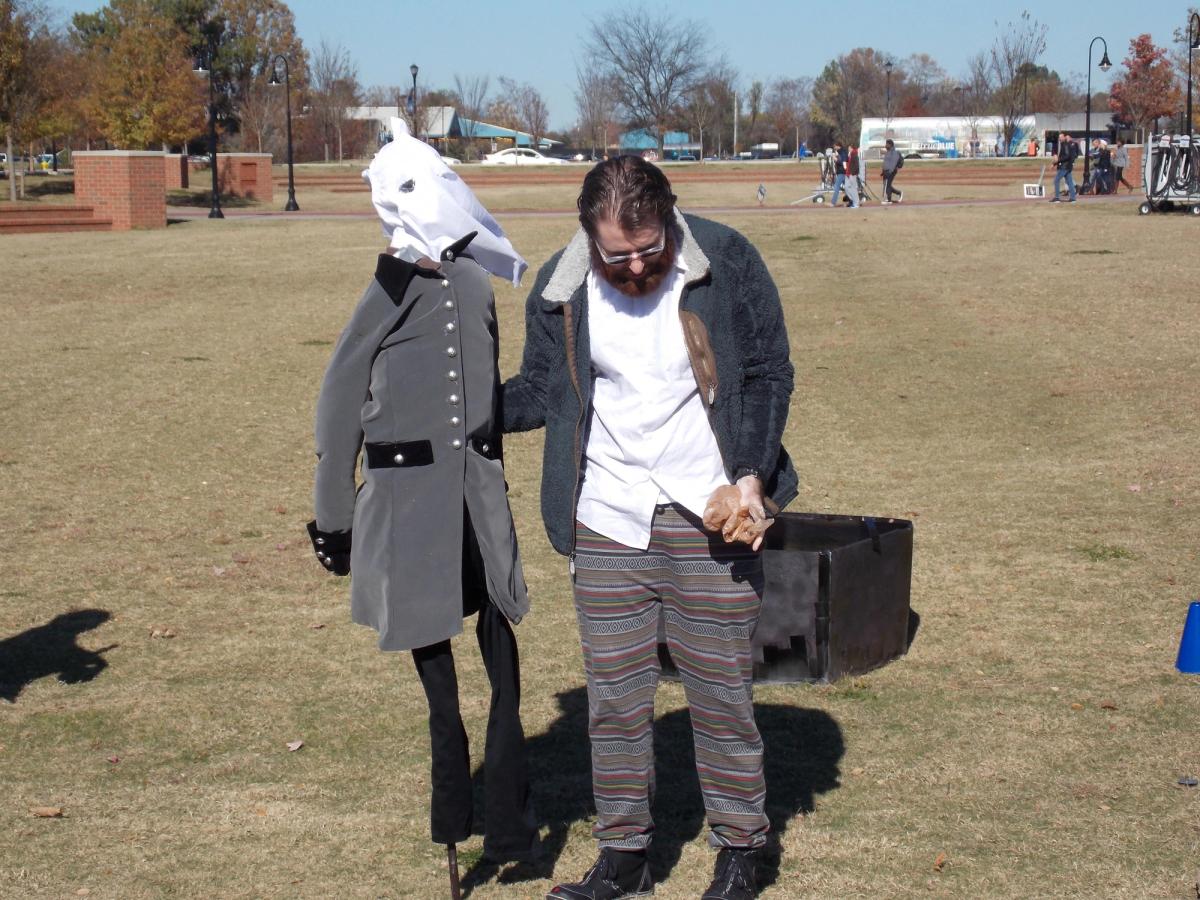
"Today we are having a burial of Nathan Bedford Forrest to send a message to the task force who refuses to acknowledge his racist past," said student organizer Dalton Winfree, according to reporting by The Sidelines, Middle Tennessee State University’s student newspaper. Winfree and other organizers had one, very clear demand for the Task Force:
“There is only one way to win in this situation. And that's to remove the name."
It wasn’t the first time students had protested Forrest’s legacy on campus. Beginning in the 1960s, there was a student-led effort to convince the school administration to remove Forrest’s name and likeness from university publicity materials. Finally, in 1989, the university took down a large bronze plaque of Forrest from the student union building, following student pressure. The 2015 resurgence of activism around the building’s name followed the Charleston Massacre, a deadly mass shooting in which a white supremacist shooter killed nine Black worshippers at the Emanuel African Methodist Episcopal Church in downtown Charleston, South Carolina.
The Charleston Massacre was a powerful catalyst to the movements of this period, Dawson argues. “It coincided with this wave of people not only wanting to get rid of things that are derogatory,” he says, “but also to challenge the way that symbols of white supremacy are embedded in campus geography.”
Despite ongoing efforts over the last decade, the campaign to change Forrest Hall’s name has so far been unsuccessful. Activists won support within the university, and the public university proposed to change the name several times. But its proposals were blocked by the Tennessee Historical Commission under a state statute to stop the removal of Confederate monuments. Even still, activists have achieved other wins, including the removal of a bust of Forrest from the state capitol in 2021, and efforts to rename the building continue.
A legacy of struggle
Reflecting on the anti-racist protests against symbols of white supremacy in this period, Dawson validated students’ “power analysis” and their “critique of how large structures of power are embedded in their everyday lives.”
“Students are connecting these dots, sometimes with the help of taking classes by professors who are also critical. But their lived experiences of these things is also a really insightful window into how power is working in their university,” Dawson says.
As the Trump administration increasingly asserts its own pseudo-histories and willful misunderstandings of our nation’s history, Dawson encourages today’s student organizers to look to the past, to understand opposition and criticism by students before them. “Sometimes it feels like you're the only one holding it down, and it's like, well, there's someone in my shoes before me, and I don't have to reinvent the wheel.”
Challenging the white supremacist histories embedded in our campus geographies and re-imaginging who deserves honor is an ongoing struggle. Just as students at Middle Tennessee State University were able to build on decades of campaigns to change the name of Forrest Hall, students today can look back at the activism of the 2010s to draw inspiration and strength for the future.
Takeaways for activists
- Counterstories are a powerful strategy. Sharing personal lived experience can change other students’ understandings of the campus environment and geographies. Telling our stories can build solidarities both with those who share similar experiences and those who don’t.
- Focus on a very specific and well-articulated demand. In many cases outlined here, when students proposed very specific demands around symbols of white supremacy, it activated university administrations to address them concretely.
- Many student protest movements targeting racist symbols were actively engaged with campus geography and history, especially retelling history from a critical perspective. To do this, they drew on diverse forms of critical analysis, including some taught in classes—making great use of the intellectual resources of the institution—and other more activist understandings.